When Doctors Don't Listen by Dr. Leana Wen
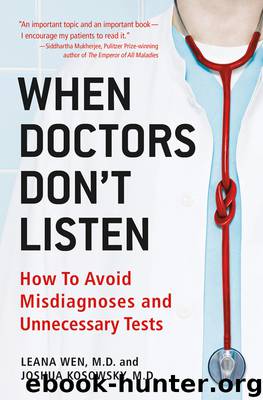
Author:Dr. Leana Wen
Language: eng
Format: epub
Publisher: St. Martin's Press
* * *
911 ACTION TIP
* * *
Any time your doctor recommends that you get a particular test, find out the risks and benefits of the test. If the risk sounds significant, ask whether it’s necessary to get the test and what the alternatives are.
* * *
“Clinicians used to be taught to rely as much as possible on their clinical acumen to make decisions,” Dr. Hoffman says. “Somehow we’ve gotten away from this, and have developed an irrational reverence of tests and rules. But tests and rules don’t make the diagnosis: doctors do. Doctors need to get a lot better at trusting their own judgment.” He adds that “every decision instrument, including the ones my colleagues and I derived and validated, should contain a clause that talks about ‘clinician gestalt,’ which, in every case where there’s a conflict, ultimately has to be allowed (in consultation with the patient) to trump whatever the rule tells you.”
* * *
Tests are not inherently evil; when there is a specific rationale, they provide much useful information. A young woman with abdominal pain for a few hours that became more localized to the right lower quadrant pain might well have appendicitis, and the risk of delaying the diagnosis probably outweighs the risk of radiation from a CT scan.10
But what if the same young woman had been having intermittent abdominal pain for a year, associated with diarrhea and constipation, and has already seen multiple doctors for this pain? It certainly doesn’t sound like acute appendicitis. Doing a CT on her would not be for any specific reason, other than that we just don’t know what else is going on. That rationale just isn’t good enough.
What if it’s not the doctor, but the patient, who is demanding the test?
Dr. Wen: The other day, I had a patient, a young financial analyst in his mid-twenties, who insisted that he wanted a CT of his head. He’d been having headaches that were worse than his usual migraines. He admitted to being under a lot of stress and sleeping little, but refused to accept that his lifestyle could have been related to his headaches. “I need a scan, a CT, a MRI, whatever,” he said. “I need to find out what’s wrong.”
Dr. Kosowsky: So what did you do?
Dr. Wen: I tried a lot of things! I explained to him about how head CTs are only good for finding certain things, like a hemorrhage, or a large tumor, or a buildup of fluid in the brain. I reassured him that we were quite confident from his history and physical exam that none of those things were likely. I talked to him about his stress at work, his worries about being fired, and how he was dealing with life in Boston now that he had just broken up with his long-term partner. I gently hinted, then more strongly stated, that the stress was the reason behind his headaches. Nothing seemed to make a difference.
Dr. Kosowsky: I bet I know what you did that worked: you made a deal with him.
Download
This site does not store any files on its server. We only index and link to content provided by other sites. Please contact the content providers to delete copyright contents if any and email us, we'll remove relevant links or contents immediately.
Unwinding Anxiety by Judson Brewer(73393)
The Art of Coaching by Elena Aguilar(53609)
The Fast Metabolism Diet Cookbook by Haylie Pomroy(21243)
Rewire Your Anxious Brain by Catherine M. Pittman(18791)
Healthy Aging For Dummies by Brent Agin & Sharon Perkins RN(17117)
Talking to Strangers by Malcolm Gladwell(13520)
The Art of Thinking Clearly by Rolf Dobelli(10700)
Mindhunter: Inside the FBI's Elite Serial Crime Unit by John E. Douglas & Mark Olshaker(9502)
Crazy Rich Asians by Kevin Kwan(9409)
The Compound Effect by Darren Hardy(9143)
Tools of Titans by Timothy Ferriss(8579)
Periodization Training for Sports by Tudor Bompa(8411)
Becoming Supernatural by Dr. Joe Dispenza(8361)
Wonder by R. J. Palacio(8226)
Bodyweight Strength Training by Jay Cardiello(8026)
Crystal Healing for Women by Mariah K. Lyons(8000)
Change Your Questions, Change Your Life by Marilee Adams(7921)
Nudge - Improving Decisions about Health, Wealth, and Happiness by Thaler Sunstein(7844)
Therapeutic Modalities for Musculoskeletal Injuries, 4E by Craig R. Denegar & Ethan Saliba & Susan Saliba(7778)
